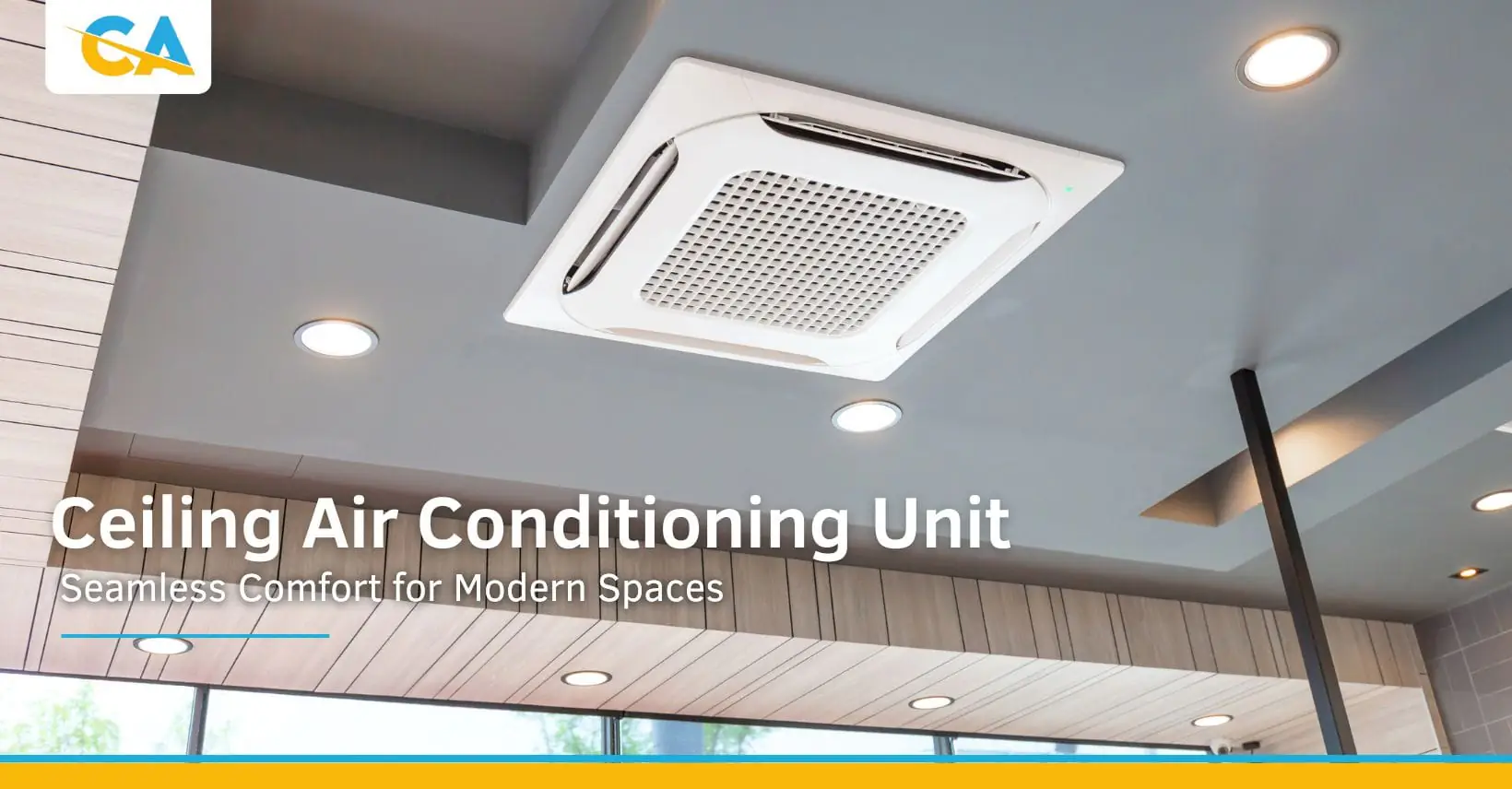
A ceiling air conditioning unit sits in or under the ceiling rather than on a wall, so it cools a room from above without taking up floor or wall space. It is a popular choice for offices, shops and other commercial buildings.
This guide explains the main types of ceiling unit, how they work, where they suit best and what to check before you buy. It also covers installation and upkeep.
What is a ceiling air conditioning unit?
A ceiling air conditioning unit is the indoor part of a split system that is fitted at ceiling level. It connects by refrigerant pipework to an outdoor condenser, which removes heat from the building. There are three main types.
Ceiling cassettes
A ceiling cassette is recessed into a suspended ceiling, so only a flat grille is visible. Many models are made to fit a standard 600 x 600 mm ceiling tile. Four-way cassettes blow air out of all four sides, giving even coverage in open-plan offices, retail showrooms and warehouses.
Ceiling-suspended units
A ceiling-suspended unit hangs just below the ceiling. It is the practical option where there is no suspended ceiling or not enough void above it, such as in older buildings, workshops or rooms with solid plaster ceilings.
Ducted units
A ducted unit is hidden completely in the ceiling void. Air travels through ducts to small grilles, so nothing but the vents can be seen. It needs more ceiling depth and a more involved installation.
How does a ceiling cassette air conditioner work?
The indoor unit draws warm air from the room through a central grille. That air passes over a coil filled with cold refrigerant, which absorbs the heat. A fan then pushes the cooled air back out through the louvres around the edge.
The refrigerant carries the heat to the outdoor unit, where a compressor and second coil release it outside. As the air cools, moisture also condenses on the coil, which is why every ceiling unit needs a condensate drain.
Benefits of ceiling-mounted air conditioning
The biggest advantage is space. With the unit overhead, walls stay free for shelving, displays or windows, and you can arrange furniture without working around an indoor unit.
Air distribution is the second key benefit. Because a cassette sends air out in several directions from the centre of a room, it avoids the warm corners and cold draughts you can get from a single wall unit blowing one way.
Ceiling units are also discreet. A cassette sits almost flush with the ceiling, and a ducted system is barely visible at all. Most modern units use inverter compressors, which speed up and slow down to match demand rather than switching fully on and off. This keeps the temperature steady, cuts wasted energy and helps keep running noise low.
Where ceiling air conditioning units work best
Ceiling cassettes are most at home in commercial buildings with suspended ceilings. Typical examples include:
- Offices and meeting rooms, where even cooling helps staff stay comfortable at every desk
- Shops and retail showrooms, where wall space is needed for stock and displays
- Restaurants and cafés, where steady airflow keeps busy dining areas comfortable
- Warehouses and trade counters, where larger units cover wide open areas
- Hotels, gyms and clinics, where a tidy, low-profile unit suits the interior
They can work in homes too, but most houses do not have a suspended ceiling, so a ducted or wall-mounted air conditioning unit is often more practical.
What to look for when choosing a ceiling unit
Cooling capacity comes first. It is measured in kilowatts (kW) or BTU, and it needs to match the heat load of the room. As well as floor area, windows, insulation, lighting, computers and the number of people in the room all add heat. An undersized unit will run flat out and struggle, while an oversized one wastes money and can leave the air feeling damp.
Next, check the energy efficiency rating. Look for the SEER figure for cooling and SCOP for heating. Higher numbers mean lower running costs for the same output.
Other features worth comparing include:
- Adjustable louvres, so you can direct air away from people and avoid draughts
- Quoted sound levels, especially for meeting rooms and quiet spaces
- Controls, such as wired wall controllers, remotes, timers or app control
- Heat pump operation, if you want the same unit to heat in winter
How are ceiling air conditioning units installed?
Installation starts with a site survey from our air conditioning team in Bolton. An engineer checks the room size, heat load, ceiling type and void depth, then plans where the indoor and outdoor units will go and how the pipework will run between them.
On the day, the indoor unit is fixed securely to the structure above the ceiling. Refrigerant pipes, power and control cables are run to the outdoor unit. A condensate drain is fitted, often with a small condensate pump where water cannot drain away by gravity. The system is then pressure tested, vacuumed and commissioned before handover.
Under F-Gas regulations, anyone handling refrigerant must be properly certified, so this is not a DIY job. Our engineers are F-Gas certified, and we are REFCOM registered with more than 20 years of experience. Based in Westhoughton, Bolton, we install ceiling cassettes, ceiling-suspended and ducted units across the UK. You can see examples in our gallery of recent installations.
Getting the best from your ceiling unit
Set a sensible temperature rather than the lowest setting, as the room will not cool any faster. Use timers so the system only runs when the building is occupied, and keep doors and windows closed while it is cooling.
Keep the filters clean, as clogged filters reduce airflow and make the unit work harder. Beyond that, a yearly professional service checks refrigerant levels, cleans the coils and drain, and spots small faults early. Our air conditioning servicing and maintenance team looks after all types of ceiling unit.
If you are planning a new system or replacing an old one, get in touch for a free site survey and quote.
Frequently asked questions
Can a ceiling cassette heat as well as cool?
Yes, most ceiling cassettes are heat pump units, which means they can reverse the refrigerant cycle to provide heating in colder months. This lets one system keep a space comfortable all year round.
How noisy is a ceiling cassette?
Ceiling cassettes are generally quiet, because the compressor, which is the noisiest part, sits in the outdoor unit. Most of the sound indoors comes from the fan, and running on a lower fan speed makes it quieter still.
How often should a ceiling air conditioning unit be serviced?
We recommend a professional service once a year, with filters cleaned more often in dusty or busy spaces. Our annual air conditioning service costs £85 plus VAT.
Can I replace an old wall unit with a ceiling cassette?
Often, yes, provided there is a suitable ceiling void and a route for the drain and pipework. The existing outdoor unit and pipes may not be compatible, so an engineer will need to survey the site first.
Categories: Air Conditioning Guide